RUKA-v2: Tendon Driven Open-Source Dexterous Hand with Wrist and Abduction for Robot Learning

1New York University 2New York University Shanghai
*Equal Contribution

Abstract

Lack of accessible and dexterous robot hardware has been a significant bottleneck to achieving human-level dexterity in robots. Last year, we released Ruka, a fully open-sourced, tendon-driven humanoid hand with 11 degrees of freedom - 2 per finger and 3 at the thumb - buildable for under $1,300. It was one of the first fully open-sourced humanoid hands, and introduced a novel data-driven approach to finger control that captures tendon dynamics within the control system. Despite these contributions, Ruka lacked two degrees of freedom essential for closely imitating human behavior: wrist mobility and finger adduction/abduction.

In this paper, we introduce Ruka-v2: a fully open-sourced, tendon-driven humanoid hand featuring a decoupled 2-DOF parallel wrist and abduction/adduction at the fingers. The parallel wrist adds smooth, independent flexion/extension and radial/ulnar deviation, enabling manipulation in confined environments such as cabinets. Abduction enables motions such as grasping thin objects, in-hand rotation, and calligraphy.

We present the design of Ruka-v2 and evaluate it against Ruka through user studies on teleoperated tasks, finding a 51.3% reduction in completion time and a 21.2% increase in success rate. We further demonstrate its full range of applications for robot learning: bimanual and single-arm teleoperation across 13 dexterous tasks, and autonomous policy learning on 3 tasks. All 3D print files, assembly instructions, controller software, and videos are open-sourced.


Hardware Design

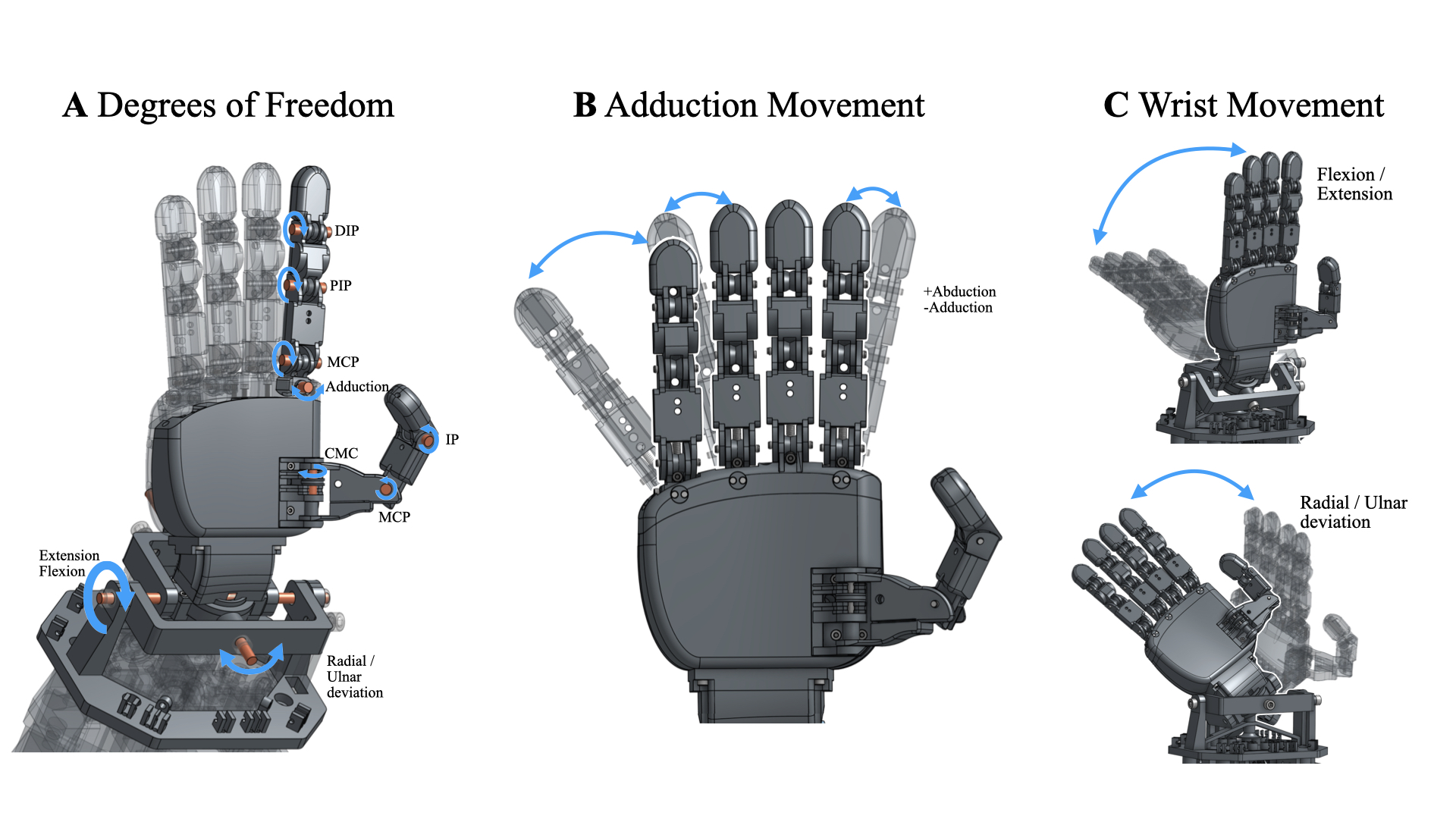
Building on RUKA, RUKA-v2 introduces two hardware capabilities critical for human-like manipulation: a decoupled 2-DOF parallel wrist and controlled finger abduction/adduction. All major structural components are 3D printed; bearings, fasteners, and springs are off-the-shelf parts. The total material cost is under $2,000, with actuators placed proximally in the forearm to reduce distal inertia and simplify maintenance.

RUKA-v2 Hardware Overview

(A) RUKA-v2 features 18 degrees of freedom across the fingers and thumb, with joints at the DIP, PIP, MCP, and Adduction axes on each finger, and IP, MCP, and CMC joints on the thumb. An additional 2-DOF wrist provides flexion/extension and radial/ulnar deviation. (B) The independent knuckle module enables abduction/adduction at the MCP joints, allowing the fingers to splay and converge laterally. The middle finger remains fixed as a structural reference. (C) The 2-DOF wrist module supports near-human range of motion: flexion/extension (top) and radial/ulnar deviation (bottom), actuated independently via decoupled parallel linkages.

Wrist Kinematics

2-DOF Wrist Kinematics

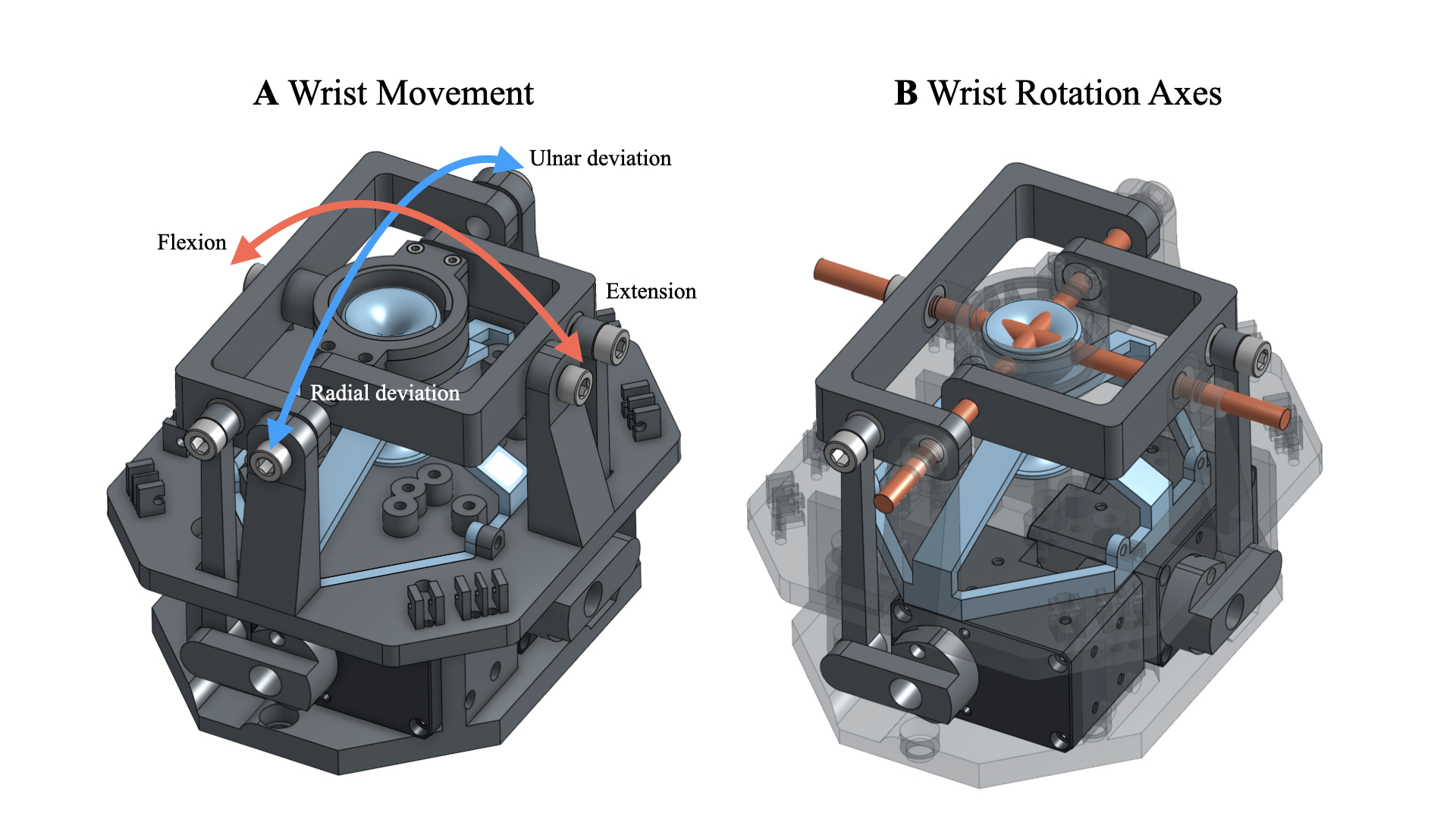
RUKA-v2 features a decoupled parallel wrist providing flexion/extension and radial/ulnar deviation, independently actuated while maintaining predictable tendon geometry. Intersecting rotation axes meet at a single pivot point defined by a passive spherical ball joint, minimizing translational palm motion during rotation and reducing cross-axis coupling.

Finger tendons pass through a through-hole near the wrist rotation center, then are redirected by a bearing-supported routing plate — limiting wrist-induced variation in tendon length and improving controllability across all wrist poses.

Finger Abduction / Adduction

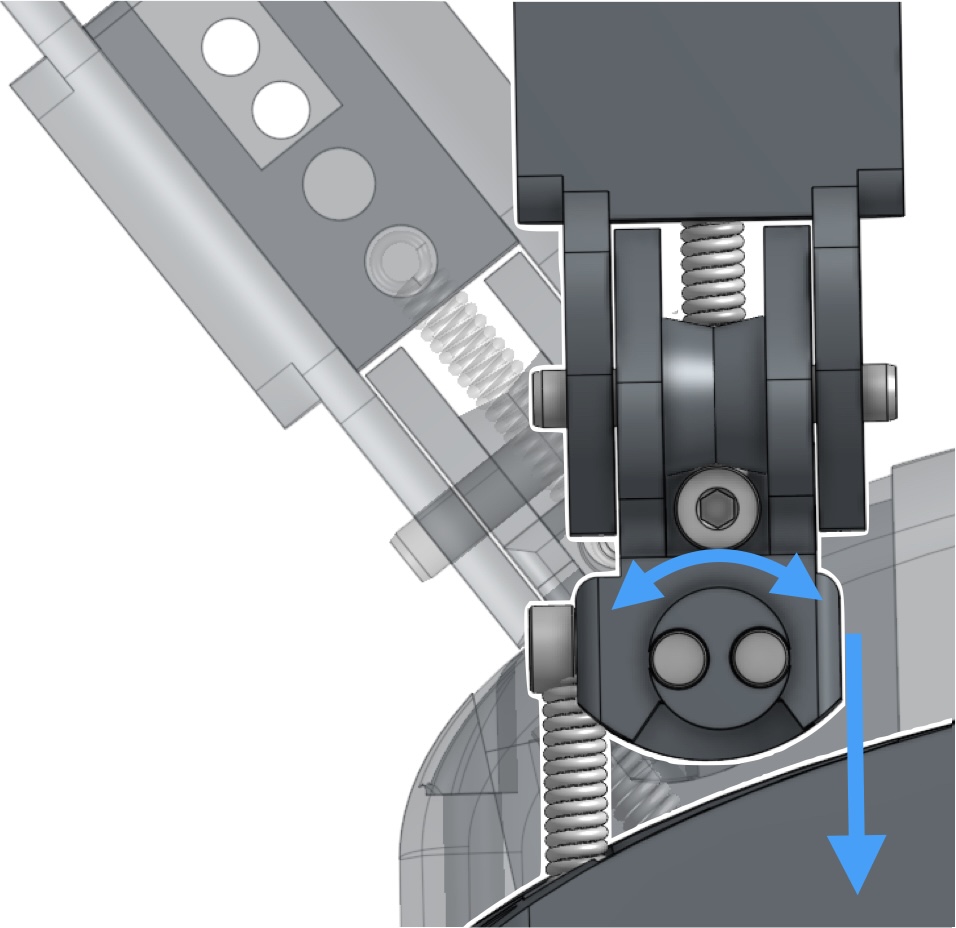
RUKA-v2 adds controlled abduction/adduction at the MCP joints via independent knuckle modules, enabling lateral finger spacing for pinching thin objects, conforming to irregular geometry, and stabilizing objects during in-hand reorientation.

Each joint is driven by a dedicated forearm tendon, with a spring return to neutral. The middle finger remains fixed as a stable geometric reference. This configuration adds passive compliance during contact and enforces a well-defined default posture.

Finger Abduction/Adduction Module

Controller

RUKA-v2's controller uses Anyteleop's vector based retargeting module and linear interpolation.

Human Video

URDF Simulation

Robot Transfer

Single Arm Teleoperation

We use Open Teach to teleoperate RUKA-v2 with the Oculus VR headset.

Picking Up Pen

Bimanual Teleoperation

Grab Bread from Oven (4x speed)

Policy Learning

We use BAKU to train autonomous visual behavior cloning policies with RUKA-v2 from teleoperated demos.

Rollout on Training Pen (3x speed)

Generalization to Plastic Knife (3.5x speed)

Payload Tests

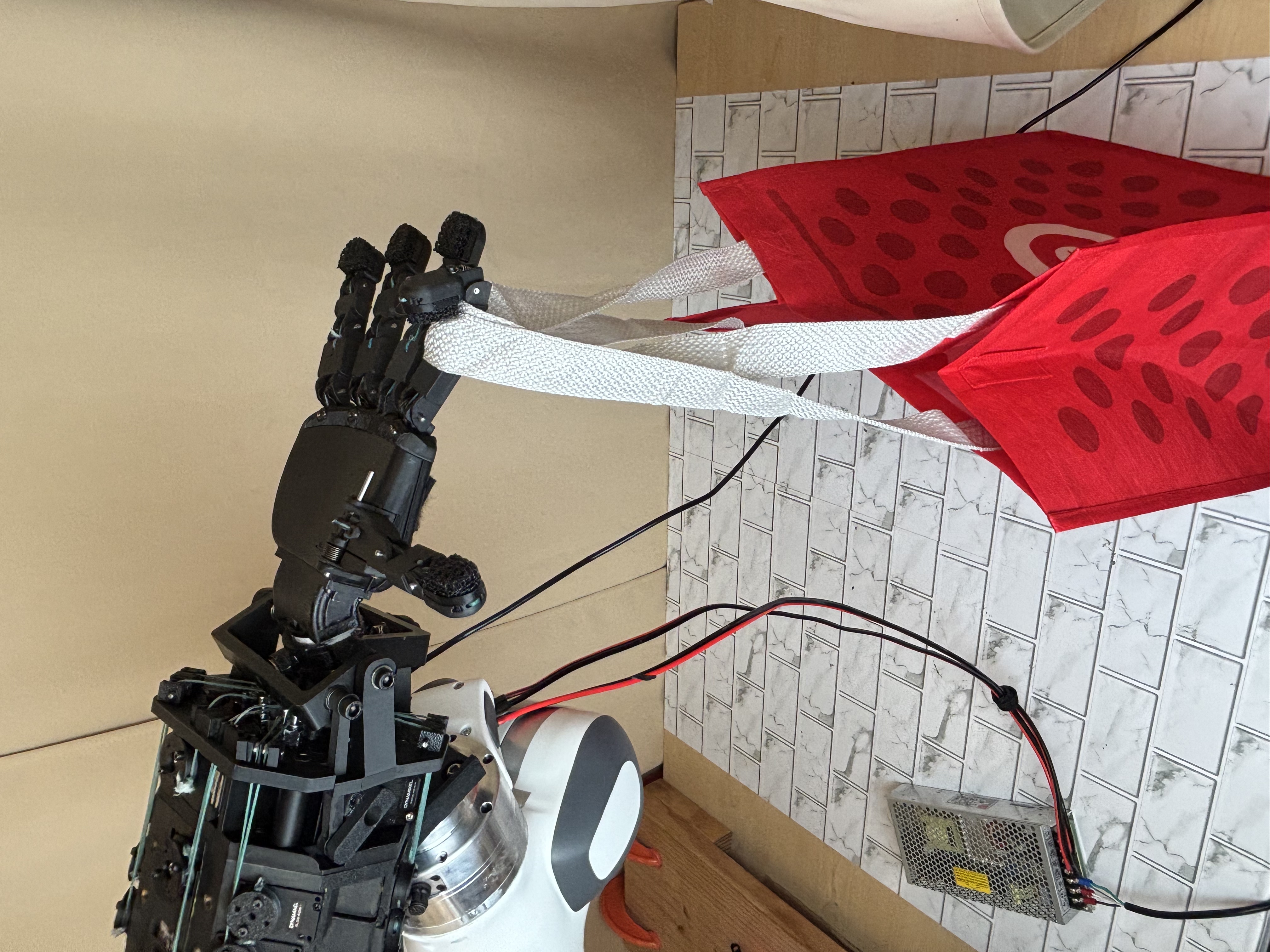
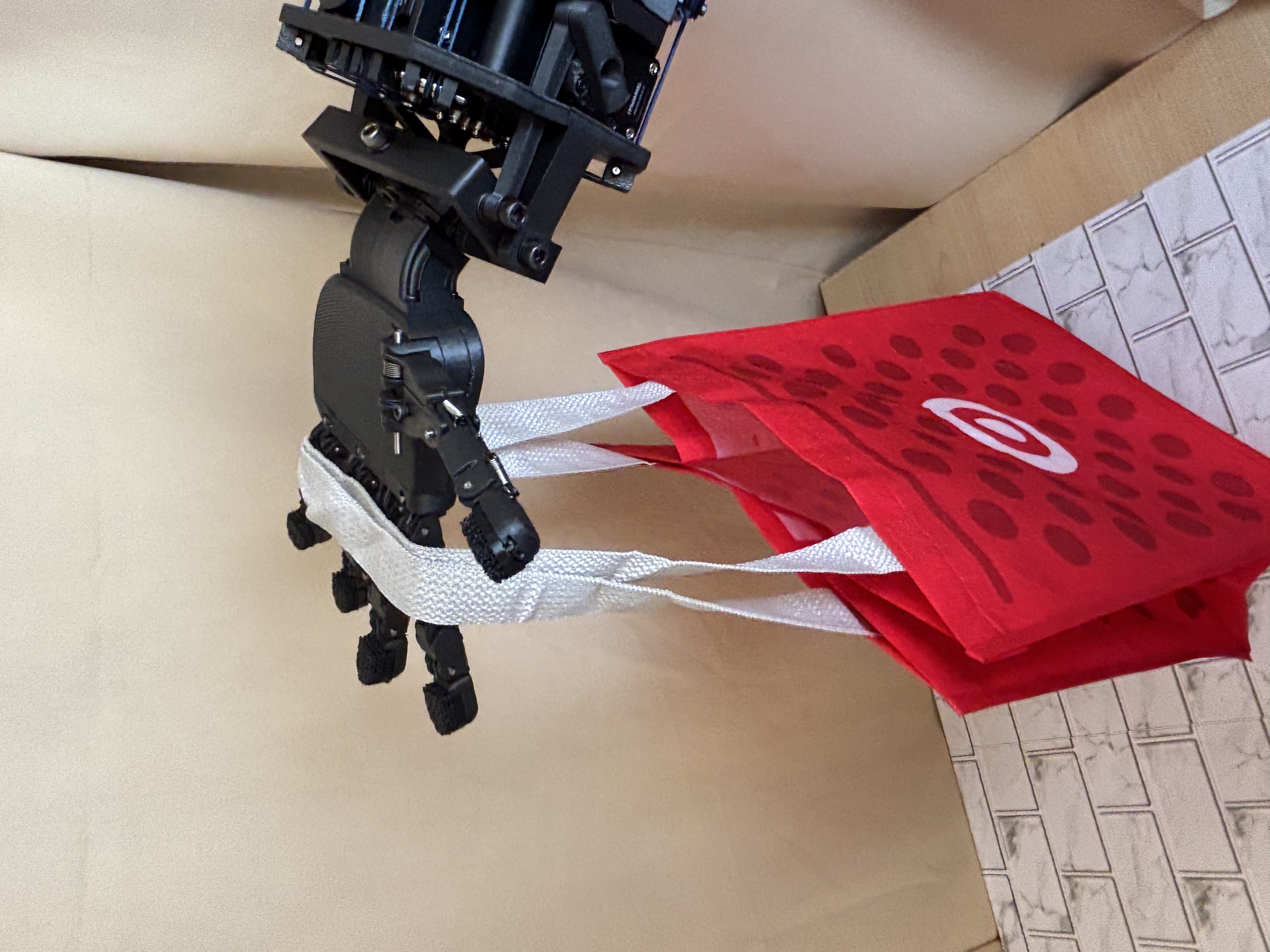
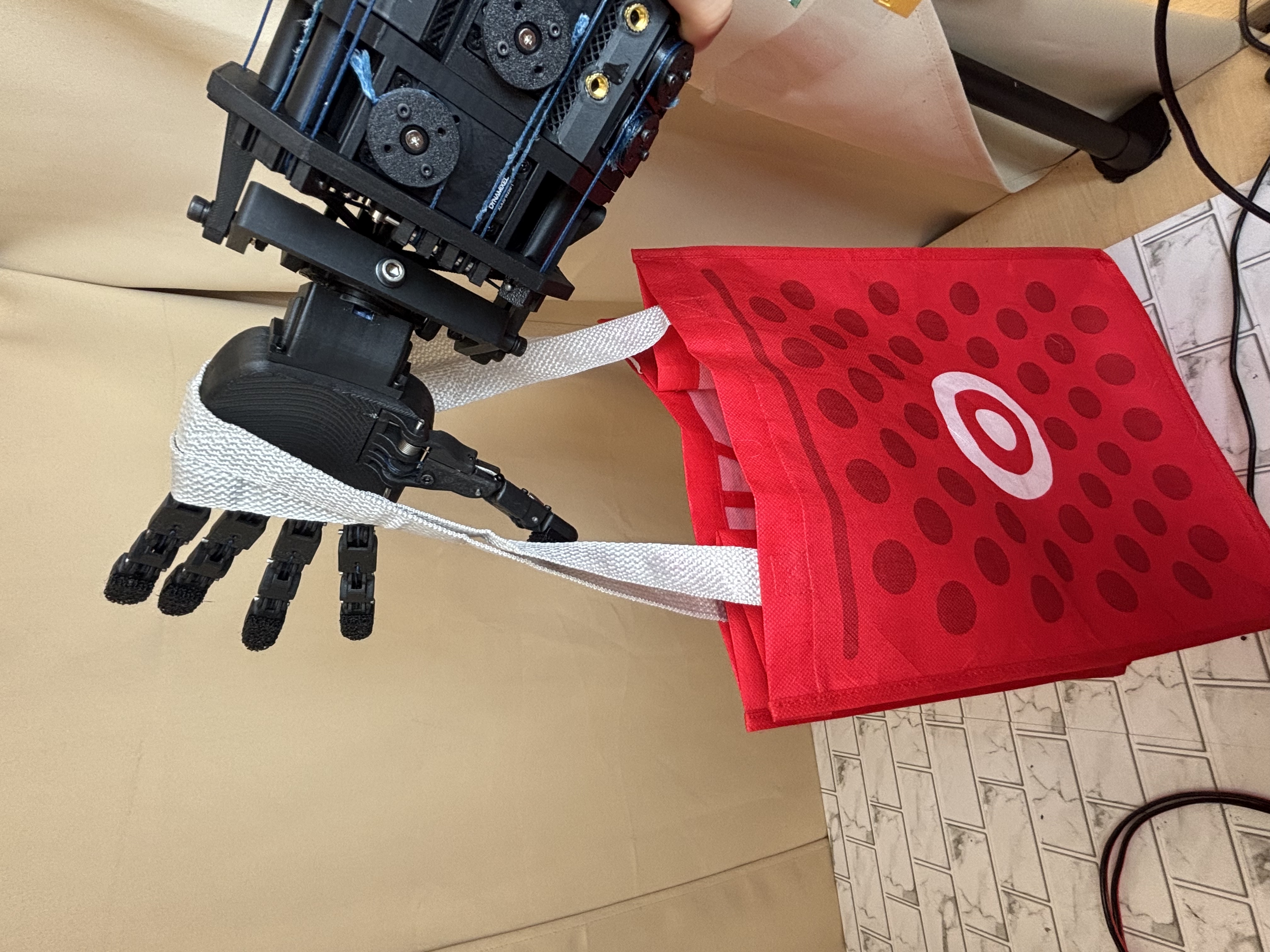
Static payload evaluation under representative loading conditions. In each trial, a bag with incrementally added weights was suspended from the hand, and the maximum load held stably for the specified duration was recorded.

Finger DIP-PIP load test

(a) Finger DIP–PIP load

Wrist supination load test

(b) Wrist supination

Wrist radial/ulnar load test

(c) Wrist radial/ulnar

Condition Max Load (g) Hold Time (s)
Non-thumb fingers DIP-PIP 1200 15
Non-thumb fingers MCP 780 15
Non-thumb fingers adduction 150 15
Thumb 835 20
Wrist (forearm supination) 1215 20
Wrist (forearm pronation) 1215 20
Wrist (radial-side-up) 835 20
Wrist (ulnar-side-up) 835 20